
8
Tires represent the only physical point of contact between a vehicle and the road. Through four small patches of rubber, each roughly the size of a postcard, an automobile accelerates, brakes, corners, and absorbs the imperfections of highway pavement. Yet drivers routinely invest hundreds or thousands of dollars into premium tires, only to watch them wear out prematurely because of neglected suspension geometry.
Wheel alignment is rarely top of mind until a vehicle pulls aggressively to one side or the steering wheel sits noticeably crooked on a straight road. By the time those obvious symptoms manifest, the damage is often already done. Routine wheel alignment is not merely a cosmetic adjustment or an optional service add-on; it is a foundational maintenance requirement that directly dictates how long your tires survive, how predictably your car responds in an emergency, and how much money you spend at the fuel pump.
The Geometry of Alignment: Camber, Caster, and Toe
To understand why alignment matters, one must first look at what technicians actually measure and adjust. An alignment does not adjust the tires themselves; it calibrates the intricate network of control arms, tie rods, bushings, and struts that connect the wheels to the chassis. Technicians balance three primary angles to ensure the wheels roll parallel to each other and perpendicular to the asphalt.
Camber and Tire Edge Contact
Camber refers to the inward or outward tilt of the top of the tire when viewed directly from the front of the vehicle. If the top of the tire leans inward toward the engine bay, it has negative camber. If it tilts outward toward the fender, it has positive camber.
While a slight degree of negative camber is standard on modern passenger cars to enhance grip during aggressive cornering, excessive tilt is destructive. When camber falls out of factory specification, the tire rides primarily on either its inside or outside shoulder rather than distributing vehicle weight evenly across the full width of the tread. The result is rapid, localized rubber loss along one edge while the rest of the tire retains usable tread.
Toe and Tread Scrubbing
Toe describes the direction the tires point relative to the centerline of the vehicle when viewed from directly above. Imagine looking down at your feet: if you turn your toes inward toward each other, that is toe-in; if you point them outward, that is toe-out.
Toe is the most critical angle for tire longevity. Even a fraction of an inch of improper toe forces the tire to scrub sideways against the pavement as it rolls forward. Instead of rotating cleanly down the highway, the tire is essentially dragged across the abrasive road surface. This drag creates a distinct wear pattern known as feathering, where the individual tread blocks wear down smoothly on one side and develop sharp, jagged edges on the other. A severe toe mismatch can destroy a brand-new set of tires in fewer than a few thousand miles.
Caster and Steering Stability
Caster represents the forward or rearward tilt of the steering axis when viewed from the side of the car. Picture the angled forks on a bicycle or the pivoting casters on a shopping cart.
Unlike camber and toe, caster does not cause significant tire wear on its own. However, it plays a massive role in directional stability and steering effort. Positive caster, where the steering axis tilts toward the driver, creates a natural self-centering force that helps the steering wheel snap back to center after making a turn. It also keeps the car tracking straight at highway speeds, resisting the tendency to wander across road ruts or drift with crosswinds. If caster is uneven between the left and right wheels, the car will pull steadily toward the side with less positive caster.
How Proper Alignment Protects Your Tire Investment
Modern tires feature complex tread compounds designed to dissipate heat, channel water away from the contact patch, and provide progressive grip. When suspension components drift out of alignment, the forces acting on the tire are thrown into disbalance.
Beyond simple edge wear and feathering, poor alignment frequently causes cupping or scalloping. When worn suspension components allow a misaligned tire to bounce or wobble slightly as it rolls, small scoops or divots are carved out of the tread blocks. Cupping produces an audible humming or roaring noise at speed that sounds remarkably like a failing wheel bearing. Once a tire develops irregular wear, rotating the tires will not reverse the condition; it merely relocates the noise to a different corner of the vehicle.
By maintaining manufacturer alignment specs, every square inch of the tread face makes uniform contact with the road. This even distribution spreads frictional heat and abrasive wear across the entire circumference and width of the tire, allowing you to achieve the full mileage rating promised by the manufacturer.
The Direct Link to Vehicle Handling and Driving Dynamics
While the economic argument for tire preservation is compelling, the safety and handling benefits of precise wheel alignment are even more critical. Handling is not just an abstract concept for sports car enthusiasts; it is what keeps your vehicle controllable when avoiding road debris, negotiating an unexpectedly sharp off-ramp, or stopping on a rain-slicked interstate.
A properly aligned vehicle feels settled, predictable, and confidence-inspiring. The steering responds linearly to driver inputs, without vague dead spots in the center or sudden darting behavior over uneven pavement.
Conversely, a car with misaligned wheels requires constant micro-corrections just to stay centered in a highway lane. This perpetual steering tension causes driver fatigue on long trips. More dangerously, severe misalignment reduces the effective contact patch of the tires. During hard emergency braking, unevenly loaded tires cannot generate maximum friction, which measurably increases stopping distances and can compromise the effectiveness of anti-lock braking (ABS) and electronic stability control (ESC) systems.
Reducing Parasitic Drag and Preserving Fuel Economy
There is also an undeniable correlation between wheel geometry and fuel efficiency. When your tires are forced to fight each other due to improper toe angles, the vehicle experiences substantial rolling resistance.
Think of rolling resistance like pushing an object across a smooth floor versus pushing it across rough carpet. When tires are aligned, they roll forward with minimal resistance. When they are misaligned and scrubbing sideways, the engine or electric powertrain must work harder and burn more energy just to maintain cruising speed. While the drop in fuel economy may only seem like a mile or two per gallon, that inefficiency compounds steadily over tens of thousands of miles, draining your wallet long before the tires are discarded.
When Should You Check Your Alignment?
Wheel alignment is not a permanent setting. Suspension components are subjected to immense dynamic loads every time a vehicle strikes a pothole, rolls over a recessed manhole cover, or nudges a concrete parking curb. Over time, rubber suspension bushings compress, ball joints wear, and mounting bolts can shift slightly under impact.
As a general rule, drivers should have their alignment verified at least once a year or every 10,000 to 12,000 miles. Beyond standard intervals, certain events demand an immediate trip to the alignment rack:
-
Installing a brand-new set of tires, ensuring the fresh rubber is protected from day one.
-
Replacing any steering or suspension component, including ball joints, tie rod ends, control arms, or struts.
-
Experiencing a severe impact with a deep pothole, curb, or roadside debris.
-
Noticing that the steering wheel is off-center while driving straight on a flat road.
-
Feeling the vehicle pull or drift persistently toward one side of the lane.
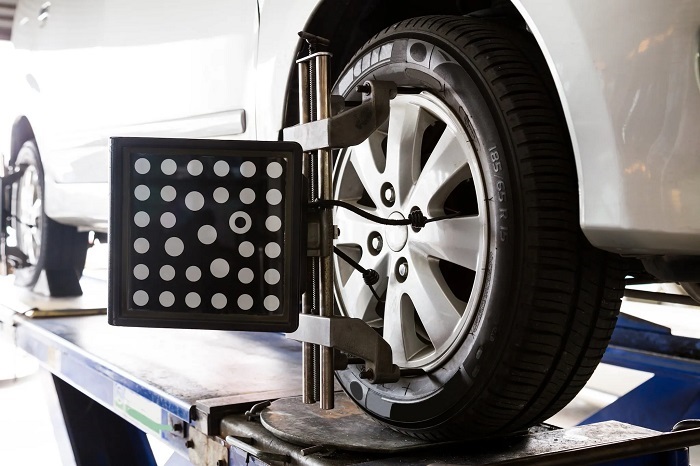
Relying on modern computerized alignment racks ensures your vehicle is calibrated back to factory tolerances, factoring in all four wheels and matching the steering angle sensor for modern vehicle stability systems.
Prioritizing regular wheel alignment transforms routine car care from an ongoing series of reactive repairs into proactive asset management. By keeping your vehicle’s suspension geometry properly dialed in, you preserve the life of your tires, extract optimal fuel mileage, and enjoy a safer, smoother, and far more responsive driving experience every time you sit behind the wheel.
